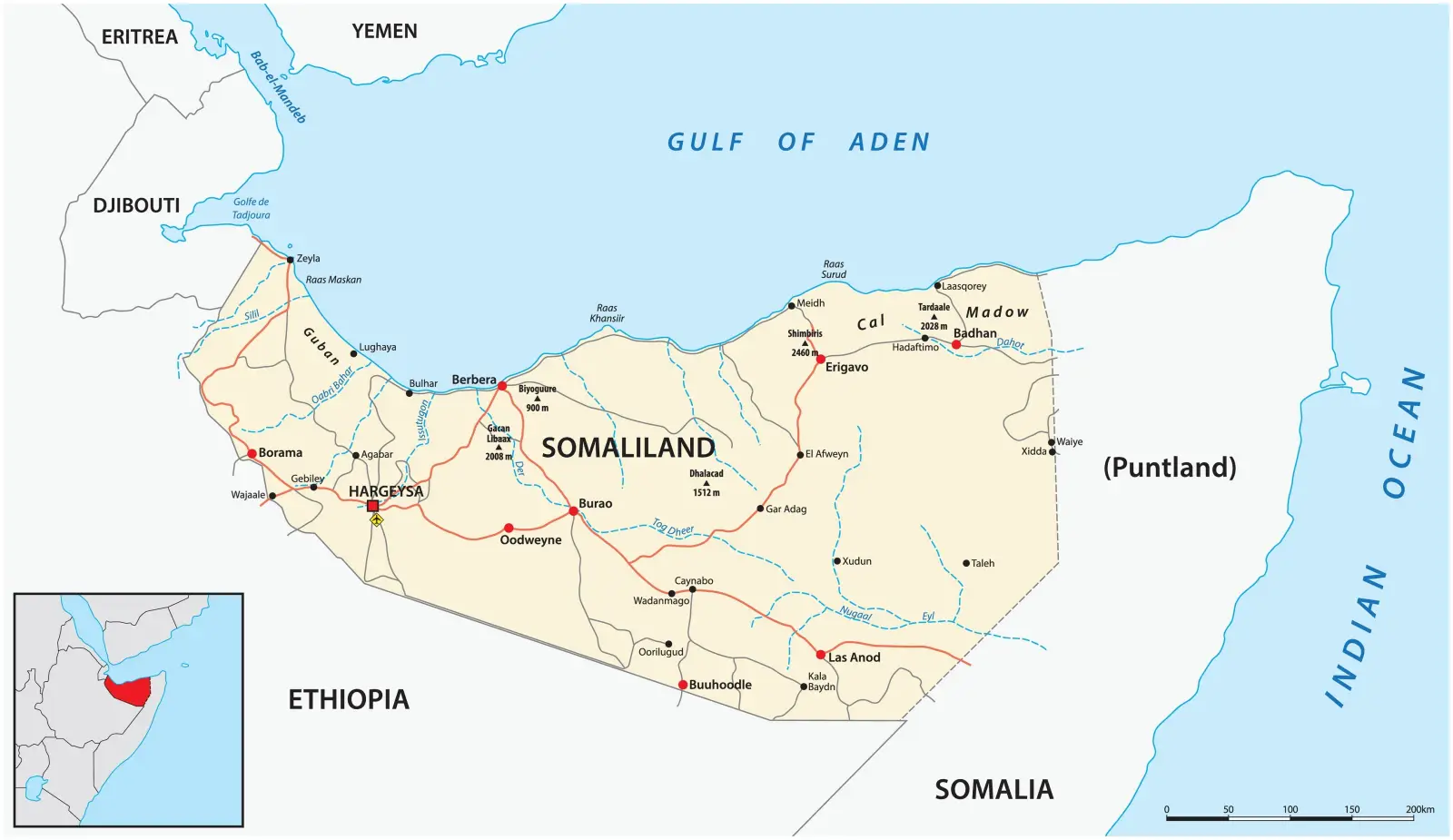
Somaliland, a self-declared state on the Horn of Africa, is drawing renewed international attention as geopolitical rivalries intensify around its strategic coastline along the Gulf of Aden.
For travellers, that matters because destinations once seen as remote or niche are increasingly shaped by global politics. Interest from foreign powers could improve infrastructure and access over time, but it also brings uncertainty to a region that remains far outside mainstream tourism.
Somaliland declared independence from Somalia in 1991 and has since maintained relative stability compared with much of the country it broke away from. It operates with its own government, currency and security forces, though it remains unrecognised internationally.
Recent reporting has pushed Somaliland further into the geopolitical spotlight, framing it as a territory that functions like a state in practice while lacking formal recognition. That contradiction has helped draw growing attention from foreign powers competing for influence in the region, as highlighted by Le Monde and Reuters.
At the centre of that interest is Berbera, a port city positioned along one of the world’s busiest maritime routes. Investment led by the United Arab Emirates through DP World has already helped turn the port into an increasingly important logistics hub, while other countries continue to monitor developments for strategic and commercial reasons.
The growing attention has also sharpened diplomatic tensions. Somaliland’s long-running push for international recognition remains contentious, with many countries continuing to back Somalia’s territorial integrity. Analysts warn that rising foreign involvement could deepen rivalries in a region already shaped by competing alliances.
Despite that uncertainty, Somaliland continues to attract a small number of adventurous travellers curious about places beyond established tourism routes. The capital, Hargeisa, offers markets, cultural sites and a glimpse into a functioning but unrecognised territory.
Among its best-known attractions are the Laas Geel cave paintings, widely regarded as some of the most significant prehistoric rock art sites in Africa. Along the coast, Berbera’s beaches remain largely undeveloped, offering a sharp contrast with crowded resort destinations elsewhere.
Tourism infrastructure, however, remains limited. Travel usually requires careful planning, local guidance and close attention to official travel advisories.
While Somaliland is often described as more stable than southern Somalia, it remains subject to travel warnings from foreign governments, and consular support for visitors can be limited. Entry requirements and passport rules are also set out in the latest UK guidance.
Local authorities have signalled ambitions to expand tourism and trade, seeking investment in roads, airports and hospitality. Any improvements, however, are likely to be shaped by wider geopolitical developments as much as by domestic priorities.
For now, Somaliland occupies a rare position on the global travel map: a place defined as much by political ambiguity as by cultural richness. As international interest grows, its future as both a strategic outpost and a potential travel destination will depend on how those competing forces evolve.
Photo Credit: Rainer Lesniewski / Shutterstock.com