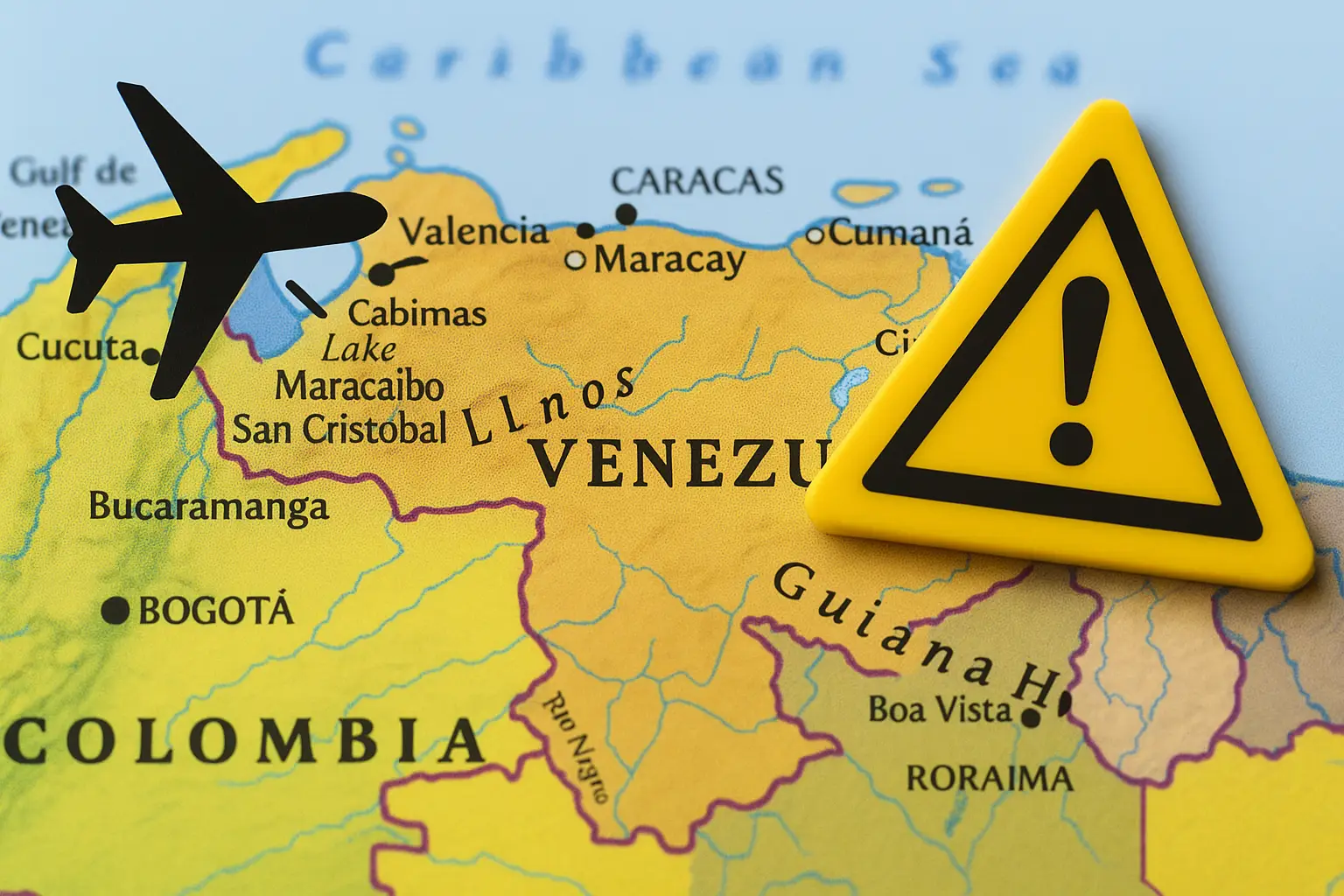
The United States launched overnight strikes on Venezuela early on Saturday, hitting the capital Caracas and other cities in a surprise military operation that immediately raised concerns for travel across northern South America and the Caribbean.
US President Donald Trump said Venezuelan President Nicolás Maduro and his wife were “captured and flown out of the country,” following what he described as a “large-scale strike” carried out during the night.
The attack, announced by Trump on social media hours after it took place, left Venezuela’s political leadership unclear and prompted uncertainty over security, transport and border controls in the region. Initial reports said multiple targets were struck in Caracas and several other Venezuelan cities, with further details expected later in the day at a scheduled US press conference.
h2>Airspace closures and flight disruptions
Venezuela’s airspace was effectively closed to civilian traffic following reports of explosions and military aircraft activity over Caracas and nearby states. Flight tracking data showed commercial carriers avoiding Venezuelan airspace within hours of the strikes, forcing reroutes for long-haul flights between North America, the Caribbean, and parts of South America.
The U.S. Federal Aviation Administration issued a notice restricting U.S. civil aviation operations in Venezuelan airspace, citing ongoing military activity and elevated risk to aircraft. Airlines operating in the region began diverting flights south over Colombia and east over the Caribbean Sea, increasing flight times and fuel costs.
Carriers serving northern South America warned passengers of delays and cancellations, particularly on routes connecting Panama, Colombia, Brazil, and the eastern Caribbean. Regional hubs including Bogotá, Panama City, and Santo Domingo reported heavier traffic as rerouted flights concentrated into fewer corridors.
Several Latin American airlines temporarily suspended services to Caracas’s Simón Bolívar International Airport, where operations were disrupted by security measures and reports of power outages. International airport authorities advised travelers to check flight status directly with airlines as schedules continued to change throughout the day.
Warnings for travelers on the ground
Foreign governments issued urgent advisories for their citizens in Venezuela following the strikes. The U.S. Embassy instructed Americans to shelter in place and avoid travel amid reports of explosions, military deployments, and limited communications. Consular services were curtailed as embassies reviewed security conditions.
Venezuela’s government condemned the operation and announced emergency measures nationwide. Vice President Delcy Rodríguez, Vice President of Venezuela, said the country rejects “military aggression,” according to state statements reported by international media. Authorities mobilized security forces and restricted movement around military installations and transport hubs.
Land borders with Colombia and Brazil remained formally open, but travelers reported heightened checks, delays, and intermittent closures. Bus operators reduced services near border regions as a precaution, while tour operators in neighboring countries advised against non-essential travel close to Venezuelan territory.
Cruise lines operating in the southern Caribbean monitored developments closely. While most itineraries do not include Venezuelan ports, companies issued internal guidance on contingency planning in case of broader regional instability affecting ports in Aruba, Curaçao, and Colombia.
Regional ripple effects
The strikes heightened security concerns across the region, prompting neighboring governments to review aviation and border protocols. Colombia called for emergency consultations at international forums, while Caribbean states emphasized the need for de-escalation to protect tourism-dependent economies.
Travel insurers warned that coverage could be affected for trips involving Venezuela, with some policies excluding losses linked to war or military action. Industry groups advised travelers to review policy terms carefully and consider postponing travel to affected areas.
Airlines and airports prepared for prolonged disruptions if restrictions remain in place. Aviation analysts noted that extended airspace closures could strain regional capacity and lead to higher fares on rerouted routes, particularly during peak travel periods.
For now, authorities continue to assess the security situation as diplomatic and military developments evolve. Travelers in northern South America and the Caribbean are being urged to monitor official advisories, confirm transport arrangements, and remain flexible as conditions remain fluid.