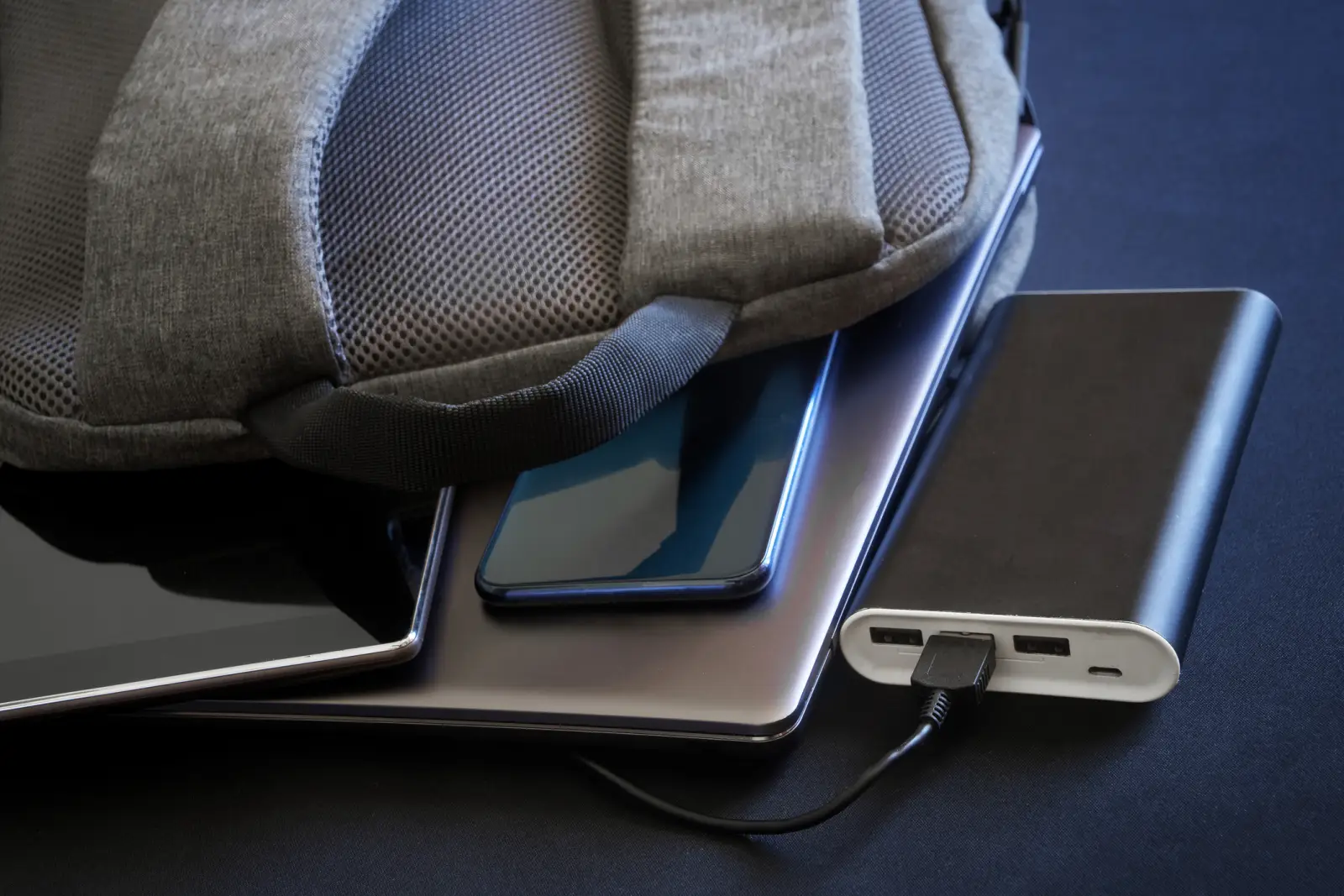
Japan’s transport ministry, working with industry groups such as The Scheduled Airlines Association of Japan, will prohibit passengers from storing power banks in overhead compartments from 8 July.
Passengers on 23 Japan-based airlines that includes Japan Airlines, All Nippon Airways, Skymark Airlines and Peach Aviation, will be required to keep their battery packs where cabin staff can monitor the devices during flight as reported in Asahi.com.
The move, announced on Monday 30 June, comes in response to a series of incidents involving such battery packs emitting smoke or catching fire during flights. Overhead bins, being less accessible during flight, pose a higher risk for unnoticed incidents. Keeping power banks nearby not only improves visibility but allows for immediate intervention if necessary.
It will also require passengers to charge their devices only in locations where the condition of the battery can be monitored — such as on their laps or in the seat pockets — as part of broader measures to ensure in-flight safety.
The transport ministry noted that while similar incidents have occurred on Japanese flights, all have been managed without serious injury or damage thanks to early detection.
Fire risk
Portable battery chargers are often a must-have for travelers. But if handled improperly, the devices can pose a fire risk. The lithium-ion batteries used in such devices can overheat or ignite due to a short circuit caused by an external impact or overcharging.
International aviation rules prohibit passengers from storing power banks in checked baggage. Batteries exceeding 160 watt-hours are banned due to the potential fire risk. Passengers may only carry two battery packs rated between 100 W and 160 W.
Passengers in South Korea must carry power banks on person
Earlier this year in January, a fire broke out on an Air Busan plane at South Korea’s Gimhae International Airport, injuring three people. South Korean investigators later said the blaze may have been caused by a power bank.
Air Busan on 4 Feb independently banned passengers from keeping power banks and e-cigarettes in luggage stored in overhead bins, being the first airline to announce such a ban.
Following this incident, South Korea implemented a regulation on 1 March, where passengers boarding flights in South Korea are required to carry portable batteries and chargers on their person rather than storing them in overhead bins. All airlines in South Korea have adopted the same policy in March.
Those using self check-in kiosks will be informed about the regulations at five different stages, including during ticket reservation, 24 hours before departure, check-in, at the boarding gate and once inside the aircraft. Airlines will also attach special stickers to approved power banks to facilitate quick security screening.
More airlines banning power banks in overhead bins
Numerous airlines around the world have announced that passengers will not be allowed to use power banks to charge their personal devices. These include Singapore Airlines, Scoot, Cathay Pacific, AirAsia, Thai Airways, Vietnam Airlines, Vietjet, Starlux Airlines, EVA Air and China Airlines.
However, some airlines have taken a step further by announcing that power banks are not allowed to be stored in overhead compartments
Effective 1 April 2025, all passengers travelling with Malaysia Airlines must carry power banks on their persons and should not be placed in the overhead compartments.
AirAsia had implemented the same policy on 1 April.
Also from April, Cathay Pacific and Hongkong Airlines said power banks cannot be stored in overhead bins.
Southwest Airline announce new regulation
Starting on May 28, Southwest Airline passengers must keep activated portable chargers in plain view, such as in a seat pocket or on a tray table, while chargers will remain permitted inside cabin luggage as long as they are powered off. Southwest Airlines is the first U.S. airline to announce such a regulation as reported by Forbes.
Lithium-fire incidents in the U.S.
The same Forbes report stated that the Federal Aviation Administration (FAA) has reported 22 lithium-fire incidents on planes this year and 620 since it began tracking such events in 2006—with more than one third (240) involving portable battery packs. In 2024, 81 lithium-battery events were reported to the FAA – an average of 1.6 per week.
On 9 April, an American Airlines flight from Indianapolis to Los Angeles was diverted to Chicago after a passenger’s portable battery charger caught fire and needed to be extinguished by crew members. On 15 January, during a United Airlines flight from Dulles, Va., to San Francisco, a passenger’s cell phone was overheated when it was being charged and crew contained the fire in a thermal containment bag.
China bans uncertified power banks on domestic flights
China will ban uncertified power banks on all domestic flights starting 28 June, as aviation authorities tighten safety rules following several onboard fire incidents linked to portable chargers.
Passengers will no longer be allowed to bring power banks that lack the official China Compulsory Certification (CCC) mark, the Civil Aviation Administration of China (CAAC) said. Power banks that have faded or illegible CCC labels or are part of a product recall will also be barred.
The rules may differ between airlines or countries. Therefore, if you are unsure of the regulations, you should check with the airline you are flying with and the airports you will be passing through before flying or even booking. For example, while portable power sources with a capacity of up to 160Wh are generally allowed, some airlines may limit the maximum capacity to 100Wh.