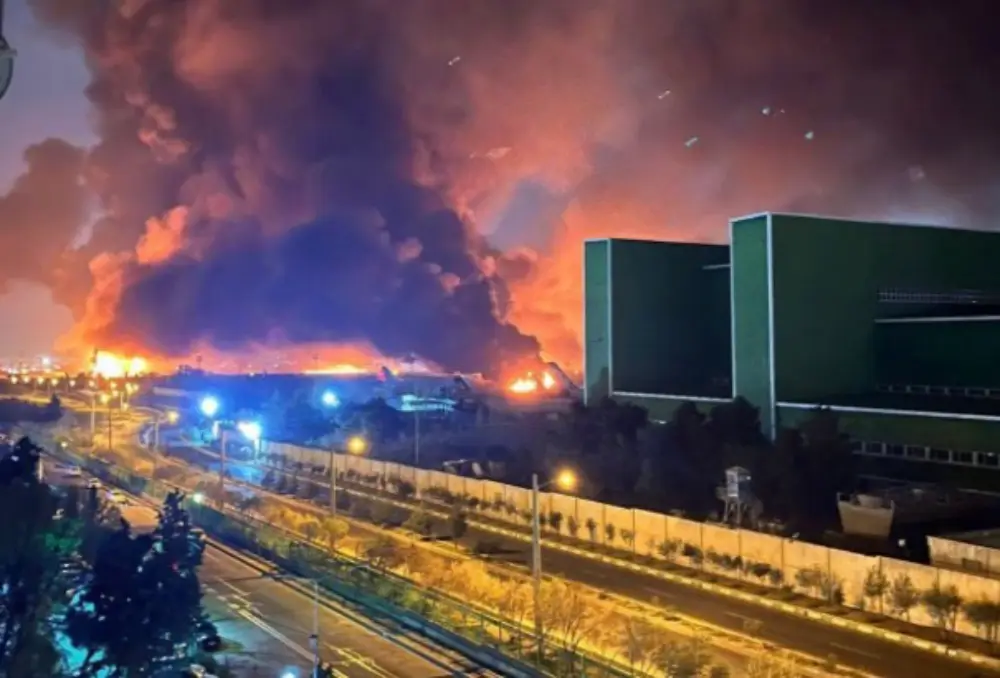
Explosions rocked Mehrabad International Airport in Tehran in the early hours of Saturday, sending aircraft on the tarmac up in flames and triggering the closure of Iranian airspace as Israel launched what it described as a broad-scale wave of strikes using more than 80 fighter jets. The attack is the most dramatic single blow to civilian aviation infrastructure since the conflict escalated, and its shockwaves are being felt across the globe.
More than 11,000 flights have been cancelled or disrupted since the latest round of strikes began, with over one million travellers affected. The crisis has forced airlines from every continent to reroute, suspend, and cancel services stretching far beyond the Middle East — from North America to the Indian subcontinent and Asia-Pacific.
A Major Airport Engulfed
Footage circulating on social media showed fierce fires engulfing Mehrabad, Tehran’s main domestic and international airport, with thick columns of smoke rising above the city. Reports indicate explosions struck fuel storage tanks within the airport complex, intensifying the blaze. At least one wide-body aircraft — believed to belong to an Iranian carrier — was filmed completely destroyed on the apron.
Eyewitness footage shows fire and smoke rising in the direction of Tehran’s Mehrabad Airport amid renewed attacks by US-Israel. pic.twitter.com/vzzzRPDGpx
— Al Arabiya English (@AlArabiya_Eng) March 7, 2026
Mehrabad, which handles the bulk of Iran’s domestic traffic as well as some international routes, has been shut indefinitely. The larger Imam Khomeini International Airport, which serves most long-haul international traffic, was also affected by the broader airspace closure, effectively sealing Iran off from the global aviation network.
Cascading Regional Airspace Closures
The strike on Mehrabad is the most visible symbol of a much wider disruption. Airspace restrictions are now in effect across Iran, Israel, Iraq, Qatar, Bahrain, and the UAE — a corridor that sits at the crossroads of some of the world’s busiest long-haul routes. The knock-on effects are hitting major global hubs far from the conflict zone, including London Heathrow, Paris Charles de Gaulle, Frankfurt, Amsterdam, Istanbul, Delhi, and Mumbai.
Turkey has extended cancellations of flights to Iran, Iraq, Syria, Lebanon, and Jordan until March 9, with Turkish Airlines suspending Iran routes until March 20. The disruption is compounding for travellers who relied on Istanbul as an alternative transit point.
Airline-by-Airline Breakdown
Emirates has managed to restore approximately 60% of its route network, operating 106 daily return flights to 83 destinations as of Saturday morning. However, the picture elsewhere is considerably bleaker:
Qatar Airways: Operations remain fully suspended, pending a Qatari airspace update.
Air France: Flights to Dubai and Riyadh suspended until March 10; Tel Aviv and Beirut until March 11.
Air Canada: All flights to Dubai and Tel Aviv are suspended until March 22.
Delta Air Lines: Disruptions on the New York–Tel Aviv route are expected to continue until March 31.
Turkish Airlines has suspended flights to Iran until March 20, while the broader suspension of all Turkish carriers (Turkish Airlines, AJet, Pegasus, and SunExpress) to Iran, Iraq, Syria, Lebanon, and Jordan has been extended until March 9. Pegasus Airlines has separately removed Iran flights from its schedule through March 12.
Stranded Travellers and Repatriation Efforts
Governments are scrambling to extract their nationals from the region. The US Embassy in Israel is offering bus service to the Egyptian border for American citizens, while Canada has arranged charter flights out of the UAE. Within the Emirates, controlled emergency corridors have enabled 60 repatriation flights, transporting nearly 17,500 passengers since the conflict intensified on March 1.
For those unable to access official repatriation programmes, the situation has become financially punishing. Private evacuation flights are reportedly commanding prices of up to €200,000 per journey. Travellers are advised to contact their embassy, airline, and travel insurance provider immediately.
A Global Ripple Effect
The suspension of services at Abu Dhabi, Doha, and Dubai — three of the world’s busiest transit hubs — is creating disruption that extends well beyond the Middle East. Travellers attempting to fly between North America and the Indian subcontinent, Africa, and the Asia-Pacific region are finding that many of their usual routings are no longer available, forcing lengthy and expensive detours via Europe or East Asia.
Energy prices have also risen approximately 25–30% since the latest escalation, with aviation analysts warning that higher insurance premiums and fuel surcharges are likely to feed through to ticket prices in the coming weeks.
What Travellers Should Do Now
Airlines are offering free rebooking and refunds on affected routes, though the process is reported to be slow given the volume of disruption. Travellers holding bookings in the region are urged to check their airline’s website directly, review their travel insurance policy carefully — noting that many standard policies contain ‘act of war’ exclusions — and register with their country’s embassy if they are currently in an affected area.
The situation remains highly fluid, with airspace statuses changing at short notice. Travellers are advised to check their government’s official travel advisory before making any decisions about onward or return travel.