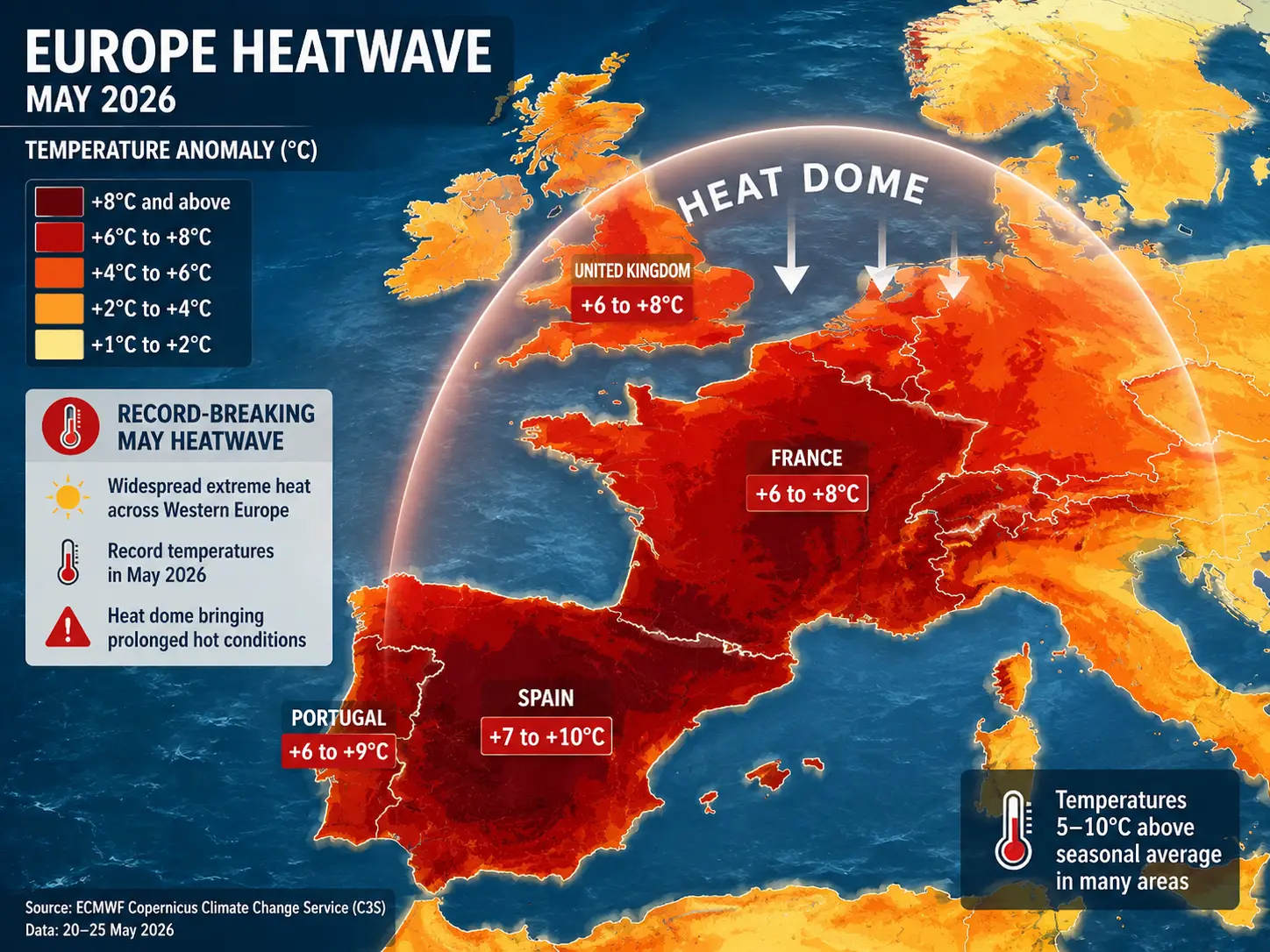
Western Europe is sweltering under the most powerful heat dome recorded so far in 2026, with temperatures running 12 to 16 degrees Celsius above long-term seasonal averages and new May records tumbling across the continent.
The heat dome, driven by a mass of hot air originating from northern Africa and locked in place by a strong high-pressure system over western Europe, is delivering mid-summer conditions to millions of travellers and residents weeks ahead of the usual season.
Spain Facing Prolonged and Intense Heat
Spain is among the worst affected countries. The State Meteorological Agency AEMET has warned that temperatures described as “extraordinarily high for this time of year” will continue across the country throughout the week, with peaks of between 36C and 38C forecast for the Guadiana and Guadalquivir regions from Wednesday to Friday.
AEMET spokesperson Ruben del Campo said the situation was clear: “Full-on summer heat is the phrase that best describes the weather we will see across most of Spain over the coming days.” Temperatures in Spain are running between 5C and 10C above the seasonal average, with northern regions reaching as much as 10C above normal for late May.
Popular holiday destinations along the Costa del Sol, Costa Blanca and the Balearic Islands including Mallorca are experiencing rapid rises in temperature, with daytime highs climbing steadily toward 30C and beyond. Southwestern Spain, including parts of Extremadura, is under formal AEMET weather warnings.
The heat is also expected to bring widespread tropical nights to southwestern Spain from Wednesday, meaning overnight temperatures will remain unusually high with very limited relief. AEMET’s seasonal forecast for May, June and July points to a very high probability that average temperatures across the entire country will remain in the highest historical brackets compared to the 1991 to 2020 reference period.
Visitors to Spain should also note that a recently introduced regulation obliges bars, restaurants and cafes to close or reduce outdoor terrace service when AEMET issues orange or red alerts for extreme heat. Establishments without adequate shade or cooling systems face mandatory closures under the rules, which carry penalties of more than 50,000 euros for non-compliance.
UK Breaks May Temperature Record by Two Degrees
In the United Kingdom, the Met Office confirmed on Monday that the country had recorded its hottest May day since records began, with 34.8C measured at Kew Gardens in southwest London. That figure exceeds the previous May record by a full two degrees. The Met Office said the heat would be “exceptional even in mid-summer, let alone May.”
Parts of England have already met the technical threshold for a heatwave after Santon Downham in Suffolk recorded temperatures above 27C for three consecutive days. The Met Office has said temperatures could reach 33C locally in the UK on Tuesday.
France and Portugal Also Under Pressure
France has broken its May temperature record of 30.5C, with temperatures peaking in the low 30s each day since Thursday and higher still forecast. Southwestern France could reach 37C to 38C during the peak of the event. Météo-France has placed large parts of the country under moderate high temperature warnings and described expected temperatures in regions such as Brittany as “quite remarkable so early in the pre-summer season.”

Portugal and Spain are unlikely to challenge their all-time May records of 40C and 44.4C respectively, but forecasters say Iberia will experience the most prolonged hot spell of any region, with temperatures expected to remain 5C to 10C above average across the peninsula through the end of May and into the first days of June.
Italy Imposes Outdoor Work Restrictions
Italy’s Lazio region, which includes Rome, approved measures on Monday limiting outdoor work “with prolonged exposure in the sun” between 12:30pm and 4:00pm. The restrictions apply to farms, construction sites and the logistics sector and run until 15 September.
The Science Behind the Heat Dome
A heat dome forms when a powerful upper-level high-pressure ridge acts as a thermal lid, trapping and compressing descending hot air near the surface. The current system originated over northwest Africa before expanding across western and central Europe. Because the pattern restricts vertical mixing and cloud cover, both maximum and minimum temperatures are being pushed to historic levels across hundreds of weather stations.
Forecasters at Severe Weather Europe warned that temperatures are soaring 12 to 16 degrees above long-term climatological norms, calling this “the strongest heat dome so far in 2026.” A study published in 2025 in the Proceedings of the National Academy of Sciences found that atmospheric patterns locking in extreme weather events such as heat domes have nearly tripled since the 1950s due to human-driven climate change.
El Nino in the Background, but Not the Immediate Cause
While searches for El Nino have spiked alongside coverage of the heat dome, scientists draw a distinction between the two phenomena. A Super El Nino event has officially begun in 2026, driven by a significant warming of the tropical Pacific Ocean. Forecasters warn it will shift the planetary jet stream and increase the likelihood of more intense heat domes across Europe and North America throughout the year.
However, meteorologists stress that El Nino is not the direct trigger for the current event. The immediate cause is the African high-pressure ridge building northward from northwest Africa and locking hot air over western Europe. El Nino sets a warmer baseline for the entire year, making record-breaking events more likely, but this particular heat dome is a synoptic weather event in its own right.
Travellers across the affected regions are advised to stay hydrated, limit outdoor activity during peak afternoon hours, seek shade and air-conditioned spaces, and monitor local weather agency alerts for any formal orange or red warning upgrades in their destination.