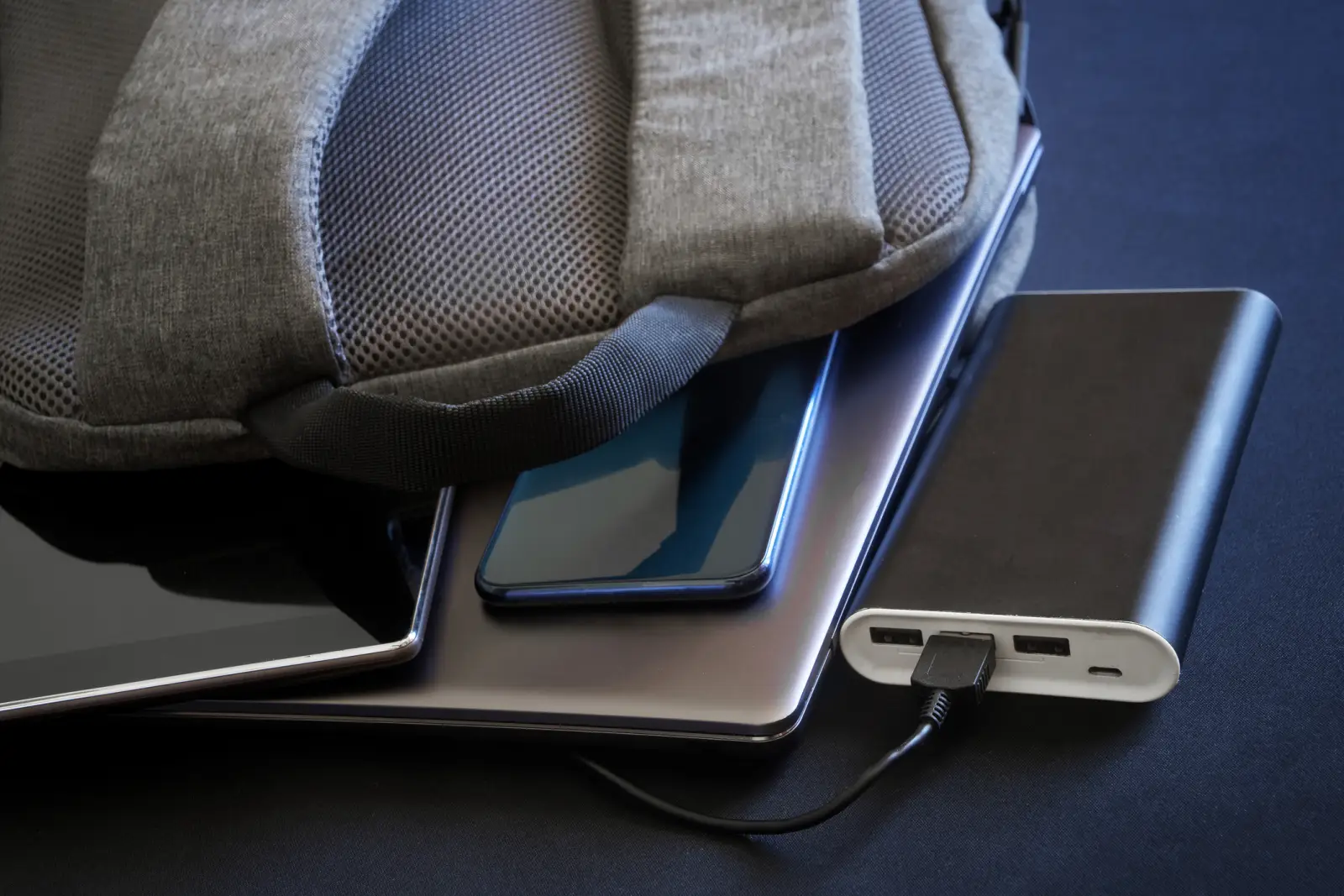
Lufthansa has tightened cabin rules for power banks and battery packs across all flights, banning passengers from charging devices using the batteries or aircraft infotainment systems, and prohibiting storage in overhead lockers.
The new restrictions take effect immediately and limit passengers to carrying no more than 2 power banks, each with a maximum capacity of 100 watt hours, or about 27,000 milliampere-hours. The policy applies to Lufthansa and its affiliated airlines, including Swiss, Eurowings, Austrian Airlines, Discover, Brussels Airlines, Edelweiss, and Air Dolomiti.
The airline says the changes follow revised safety recommendations from the European Union Aviation Safety Agency and growing concern among carriers after several onboard fires linked to lithium battery devices. Power banks remain permitted in cabin baggage but must be worn on the traveller’s person or stored under the seat, while carriage in checked luggage remains prohibited. Passengers wishing to carry larger battery packs must request approval in advance or risk confiscation and destruction of the device.
What the new rules mean for passengers
Under the updated policy, travellers flying on Lufthansa-operated or group airline services may no longer use portable batteries to recharge mobile phones, tablets or laptops during flight. Charging devices via the aircraft’s seatback infotainment system using a personal power bank is also prohibited. Instead, passengers must ensure their devices are charged before boarding or use the aircraft’s dedicated USB ports where available.
The airline has also introduced stricter storage requirements. Power banks must not be placed in overhead luggage compartments, a measure intended to allow cabin crew to respond more quickly if a device overheats or ignites. Travellers may keep batteries on their person or stow them in hand luggage under the seat in front, where visual monitoring is easier.
Capacity limits have also been standardised. Each passenger may carry a maximum of 2 power banks, and each unit must not exceed 100 watt hours, a threshold widely used across the aviation industry for lithium battery safety. Travellers who require higher-capacity battery packs, such as for specialised medical or professional equipment, must notify the airline in advance and obtain approval before travel.
Failure to comply with the policy may result in devices being confiscated and destroyed at the airport. Lufthansa has advised passengers to check the rated capacity printed on their power banks and to pack them accordingly to avoid delays or loss of equipment at security screening or boarding.
Why airlines are tightening battery policies
Airlines globally are becoming more cautious in their handling of lithium batteries after a series of incidents involving overheating and fires in cabins and cargo holds. A high-profile case in January last year involved an Air Busan Airbus A321 that caught fire while still on the ground. Authorities later concluded that a charred power bank stored in an overhead compartment triggered the blaze, injuring 27 people and forcing passengers to evacuate via emergency slides.
Investigators reported that the aircraft fuselage became engulfed in flames within minutes, highlighting how quickly lithium battery fires can escalate in confined environments. The incident prompted aviation safety agencies worldwide to reassess existing rules governing the carriage, storage and use of battery packs on commercial flights.
In Europe, updated guidance from the European Union Aviation Safety Agency has encouraged carriers to reduce risks by limiting where batteries can be stored and how they are used during flight. Lufthansa’s policy shift positions the group among the first major European airlines to fully implement these stricter measures across its network.
For travellers, the changes reflect a broader trend toward tighter cabin safety controls rather than a blanket ban on portable batteries. Power banks remain permitted in carry-on luggage, but passengers are expected to plan ahead, ensure compliance with capacity limits and rely on onboard USB charging rather than personal battery packs while airborne.
Travel industry analysts say similar policies may be adopted by other airlines as regulators continue to evaluate lithium battery risks. With smartphones, wireless headphones and laptops now essential travel companions, airlines face the challenge of balancing passenger convenience with the need to prevent rare but potentially serious safety incidents in the air.
For now, passengers flying with Lufthansa and its partner airlines are advised to review the updated rules before packing and to allow extra time at the airport in case additional screening or checks are required. The airline has indicated that enforcement will be consistent across its fleet and regional subsidiaries to ensure uniform safety standards.