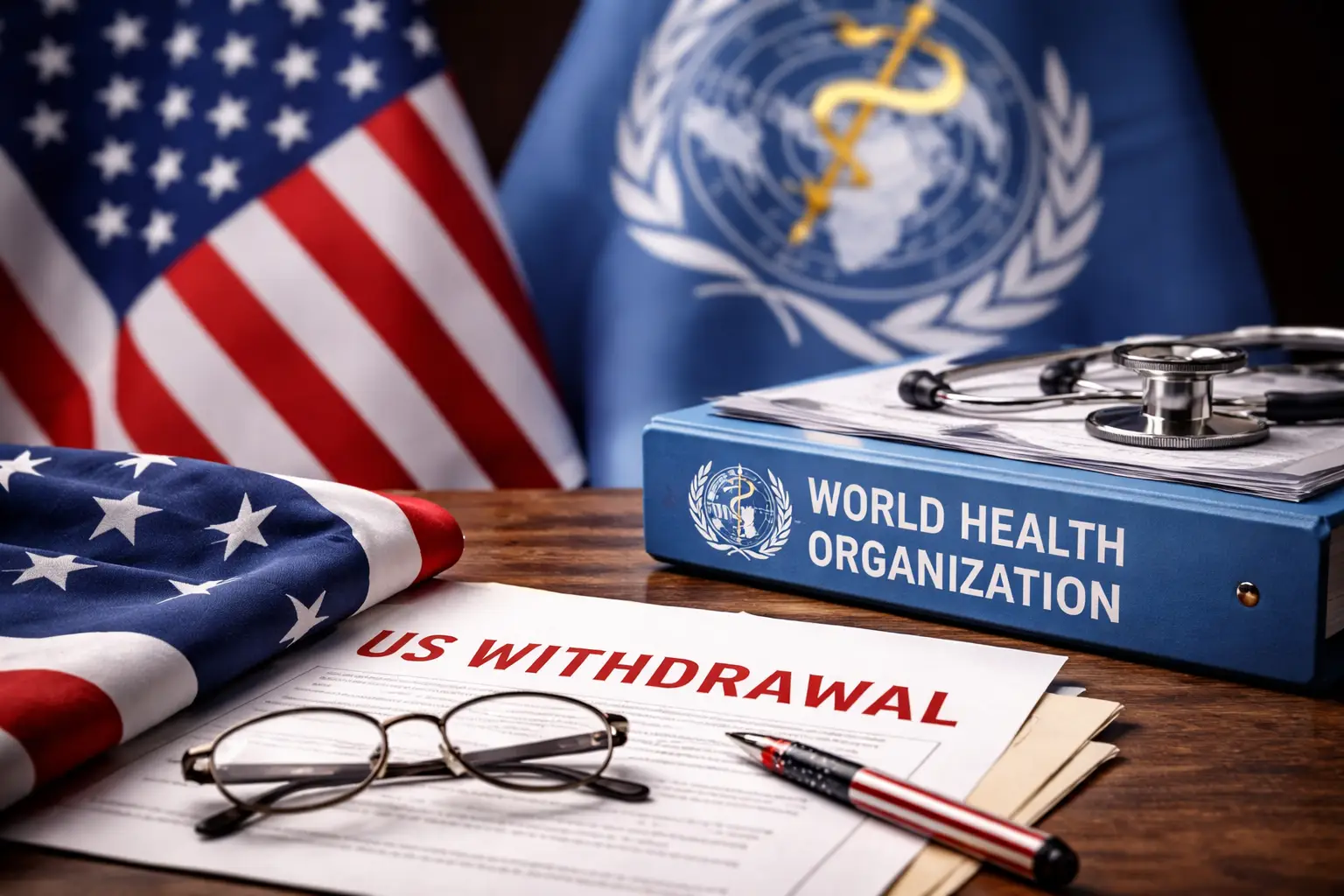
The United States has completed its withdrawal from the World Health Organization, ending nearly 80 years of membership and cutting off formal participation in the world’s main global health coordination body.
The move, finalized by the Trump administration on Thursday, halts US funding, recalls US personnel from WHO programs, and ends official involvement in committees that monitor outbreaks and guide vaccine decisions, reported on CNN.com. Health experts say the decision could weaken early warning systems for new diseases and slow responses when the next major outbreak emerges.
Federal officials say the US will pursue direct partnerships with individual countries instead of working through the WHO, but acknowledge that key details remain unresolved, including access to international disease data, according to CBS News. Public health specialists warn that replacing the WHO’s global network with a patchwork of bilateral agreements could leave gaps in surveillance, data sharing, and coordinated response during fast-moving health emergencies.
How the withdrawal changes disease surveillance and vaccine planning
On Thursday, the Department of Health and Human Services said all US government funding to the WHO had been terminated and that all personnel and contractors embedded with the organization had been recalled. The agency also said the US has ceased official participation in WHO-sponsored committees, leadership bodies, governance structures, and technical working groups.
That includes groups that assess which flu strains are circulating worldwide and help determine the composition of seasonal vaccines. Asked whether the US would participate in an upcoming WHO-led meeting on flu vaccine selection, the administration said discussions were still ongoing, leaving uncertainty around future involvement.
During a call with reporters, a senior administration official said the United States has “not been getting much return for our value, on our money, on the personnel that we’ve given.” The official added, “A promise made and a promise kept,” and said the WHO “has acted contrary to the US interest in protecting the American public.”
HHS also criticized the WHO’s handling of the COVID-19 pandemic, saying the organization delayed declaring a global public health emergency and praised China’s response despite concerns about early underreporting and suppressed information. The agency said the WHO downplayed airborne transmission and the role of asymptomatic spread.
Legal and financial questions remain unresolved. The US still owes roughly $260 million to the WHO, according to CNN. “As a matter of law, it is very clear that the United States cannot officially withdraw from WHO unless it pays its outstanding financial obligations,” said Dr. Lawrence Gostin, an expert on global health law and public health at Georgetown University. “But WHO has no power to force the US to pay what it owes.”
WHO could theoretically pass a resolution blocking the withdrawal until payment is made, but Gostin said the organization is unlikely to escalate tensions when the administration appears determined to leave.
CBS News reported that the US has not paid any of its dues for 2024 and 2025, leaving a balance of more than $133 million, according to WHO. An administration official denied that payment was required before withdrawal.
Beyond finances, experts say access to global disease intelligence is the most immediate concern. Such systems allow scientists to spot unusual clusters of illness, analyze viral mutations, and coordinate responses before outbreaks spread widely. Gostin told CBS News that losing access to this network could weaken the ability of US researchers and pharmaceutical companies to develop vaccines and treatments quickly.
“In my opinion, it’s the most ruinous presidential decision in my lifetime,” he said.
The WHO coordinates responses to outbreaks such as mpox, Ebola, and polio, supports vaccination campaigns in lower-income countries, and sets technical guidelines used by health agencies worldwide. Nearly every country belongs to the organization, creating a centralized platform for sharing information across borders.
According to HHS figures cited by CBS News, the US pays about $111 million a year in member dues and roughly $570 million more in voluntary contributions. The loss of that funding has already forced the WHO to scale back operations, said Dr. Judd Walson, an infectious disease physician and professor at Johns Hopkins University.
“There’s an estimated over 750,000 excess deaths that will occur this year because of these changes, most of those in children,” Walson told CBS News. Without US participation and funding, he said, the WHO has had to “downsize considerably.”
“There’s less resources for data monitoring for potential threats such as pandemics, emerging disease threats. There’s less resources for helping to support supply chains. All of those direct impacts of the financial consequences of our withdrawal are real, and there are many other impacts as well,” he said.
Can bilateral partnerships replace a global system?
The administration says the US will continue to collaborate internationally through agreements with individual countries, non-governmental organizations, and religious groups, with efforts led by the Centers for Disease Control and Prevention’s Global Health Center. Officials said more details and announcements are expected in coming months.
“We’ve assessed all of the gaps and the potential gaps. We’ve done analysis. We have plans in place. We will continue to work through countries and the ministries of health as we have for decades, and we’ll continue to develop those relationships and utilize those relationships in a way that’s mutually beneficial,” another senior administration official said.
Some experts argue that bilateral arrangements cannot replicate the scale and speed of a centralized global health body. A former CDC official told CNN that such an approach could create a fragmented system that lacks consistent surveillance coverage and sustainable funding. The official noted that CDC staff operate in about 60 countries, leaving large parts of the world without direct US presence.
“It doesn’t allow the same level of partnership and surveillance as working with WHO,” the former official said. “There’s not enough funding to replace it all.”
Gostin raised similar concerns to CBS News, questioning whether countries facing trade disputes or political tensions with the US would agree to share sensitive health data. “Is China going to sign a contract with the United States?” he said. “Are countries in Africa going to do it? Are the countries Trump has slapped with a huge tariff going to send us their data? The claim is almost laughable.”
Critics warn that weakened data sharing could delay detection of new threats and slow access to virus samples needed to design vaccines. Gostin said the US may lose rapid access to epidemiological data, genomic sequencing, and early outbreak intelligence that supports fast development of treatments.
“When the next pandemic hits (and it will) the United States will not be prepared and our response will be slow and weak. That harms all Americans,” he said.
Medical groups have echoed those warnings. Dr. Ronald Nahass, president of the Infectious Disease Society of America, said the decision undermines basic principles of disease control. “The U.S. withdrawal from the World Health Organization is a shortsighted and misguided abandonment of our global health commitments. Global cooperation and communication are critical to keep our own citizens protected because germs do not respect borders,” he said in a statement reported by CNN.
“Withdrawing from the World Health Organization is scientifically reckless. It fails to acknowledge the fundamental natural history of infectious diseases. Global cooperation is not a luxury; it is a biological necessity,” Nahass added.
Dr. Michael Osterholm, who directs the Center for Infectious Disease Research and Policy at the University of Minnesota, warned that outbreaks abroad could reach the US faster without coordinated global response. “Today is a day where the world’s public health took a sad and consequential hit. We will experience more deadly worldwide outbreaks,” he said. “They will occur because the experts in the US public health community won’t be at the table to lead the global response.”
WHO Director-General Dr. Tedros Adhanom Ghebreyesus previously called the US withdrawal a “lose-lose” outcome. “The US loses, and the rest of the world, we know for sure, loses,” he said during a news conference last spring.
While administration officials argue the move restores US policy independence and reduces reliance on what they describe as unaccountable international bureaucracy, the long-term impact on outbreak preparedness remains uncertain. For travelers, health authorities, and researchers alike, the central question is whether a decentralized network of partnerships can deliver the same early warning, coordination, and speed once provided by the WHO’s global system.