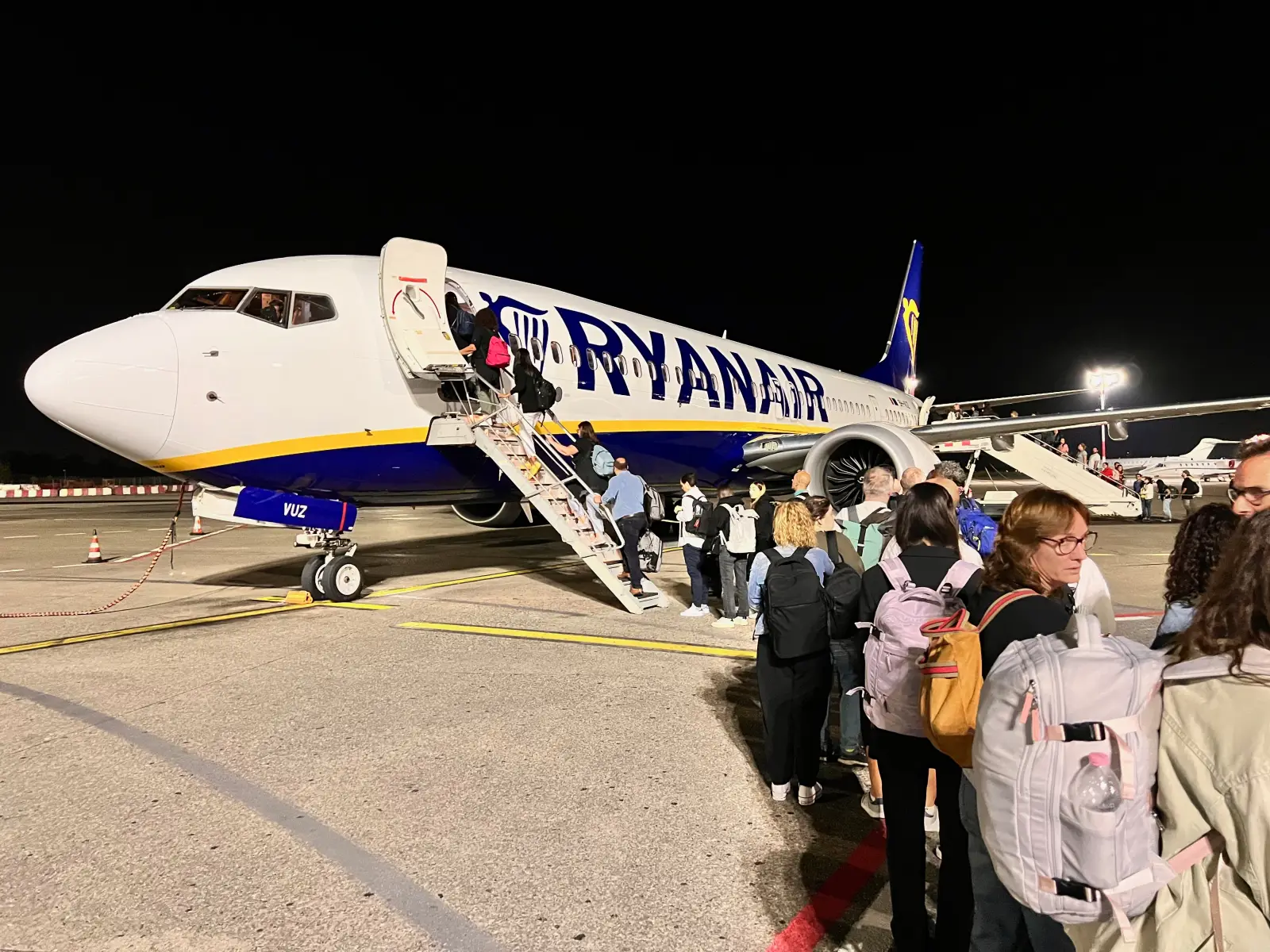
Ryanair has announced its third round of capacity cuts in Spain, eliminating 1.2 million seats from its 2026 summer schedule in response to a planned increase in airport charges by Aena, Spain’s airport operator.
The decision, confirmed by Ryanair CEO Michael O’Leary during a press briefing in Madrid, will primarily affect regional airports, including the complete withdrawal of services to and from Asturias Airport.
The cuts apply to the summer season from late March to early October 2026 and mark another reduction in the Irish carrier’s Spanish operations after previous capacity adjustments in 2025. Ryanair has already removed 800,000 seats for the summer 2025 schedule and 1 million seats from the winter 2025–2026 program, bringing total reductions to more than 3 million seats across three consecutive seasons.
Ryanair Pulls Out of Asturias and Reduces Regional Operations
As part of the latest decision, Ryanair will discontinue all flights to and from Asturias, following earlier withdrawals from Valladolid, Jaén, Vigo, and Tenerife Norte. The company stated that the move is directly linked to Aena’s plan to raise airport tariffs by 6.5% in 2026, resulting in fees of €11.03 per passenger — an increase of €0.68. O’Leary criticized the decision, warning that higher costs will undermine regional air connectivity and slow passenger growth in smaller markets.
“If Aena raises its fees, we will remove capacity from regional airports and move it to more profitable ones, both in Spain and abroad,” said O’Leary. The airline plans to add approximately 600,000 new seats at major hubs such as Madrid, Barcelona, Málaga, and Palma de Mallorca, offsetting some of the reductions in smaller destinations.
O’Leary argued that Aena’s pricing model fails to differentiate sufficiently between large and regional airports, calling for a targeted 50% reduction in charges at airports with low utilization rates, such as Valladolid and Jerez, where capacity currently stands at about 20%. “Airports like Valladolid or Jerez need at least a 50% cut in fees to stimulate traffic. It’s not the same to fly to Barcelona as to Santander, where demand must be encouraged by lowering prices,” he said.
Regional Cuts Contrast with Expansion in Major Hubs
Ryanair’s strategy will see continued consolidation of operations at Spain’s busiest airports, where the airline expects to benefit from higher passenger volumes and better economies of scale. The carrier has also signaled its intention to expand in countries such as Morocco, Italy, and Croatia, where airport fees are lower. “We want to reward markets with competitive airport charges,” O’Leary added.
The airline’s withdrawal from smaller Spanish airports continues a trend that began in 2023, when it closed its base at Santiago de Compostela and reduced operations there by 80%. The company also eliminated flights to Vigo and Tenerife Norte and reduced capacity in Asturias by 16%, Santander by 38%, Zaragoza by 45%, and Vitoria by 2%. In the Canary Islands, Ryanair cut 10% of its capacity in Gran Canaria, Lanzarote, and Fuerteventura while closing bases in Valladolid and Jerez.
According to Ryanair, these cuts are necessary to maintain profitability amid rising costs. The airline has repeatedly described Aena as a “monopoly” and accused it of applying uniform charges regardless of airport size or economic impact. O’Leary claimed that the Spanish government has ignored multiple proposals from the airline to expand its operations. One of those plans aimed to increase Ryanair’s traffic in Spain by 40% by 2030, reaching 77 million passengers per year.
European Dispute and Regulatory Tensions
The announcement coincides with growing regulatory tension between Ryanair and Spanish authorities. On the same day the airline revealed its summer 2026 capacity cuts, the European Commission opened an infringement procedure against Spain over a €179 million fine imposed by the Ministry of Consumer Affairs. The penalty targeted Ryanair and several other low-cost airlines for charging passengers additional fees for carry-on baggage.
Ryanair welcomed the Commission’s decision, calling it a “very important step” in defending low-cost carriers’ pricing models. The company has asked for the fine to be withdrawn, arguing that it violates European Union competition rules. However, Spain’s Ministry of Consumer Affairs announced that it would appeal to the Court of Justice of the European Union, stating that it would defend “with full rigor” its position under national consumer protection laws.
The dispute adds to Ryanair’s complex relationship with Spanish regulators and underscores the growing friction between airlines and airport operators across Europe over rising infrastructure costs. Industry analysts say the airline’s latest moves could significantly affect regional tourism flows in Spain, particularly in smaller destinations that rely heavily on low-cost air connections for international access.
Despite the cuts, Ryanair remains Spain’s largest airline by passenger volume and continues to view the market as strategically important. The company has indicated it could restore routes and capacity if Aena reconsiders its tariff policy for regional airports. For now, however, O’Leary has made clear that Ryanair’s focus will shift toward larger Spanish hubs and more cost-efficient markets abroad. “If fees go up, traffic will go down,” he said. “We can grow where governments value tourism and air connectivity.”