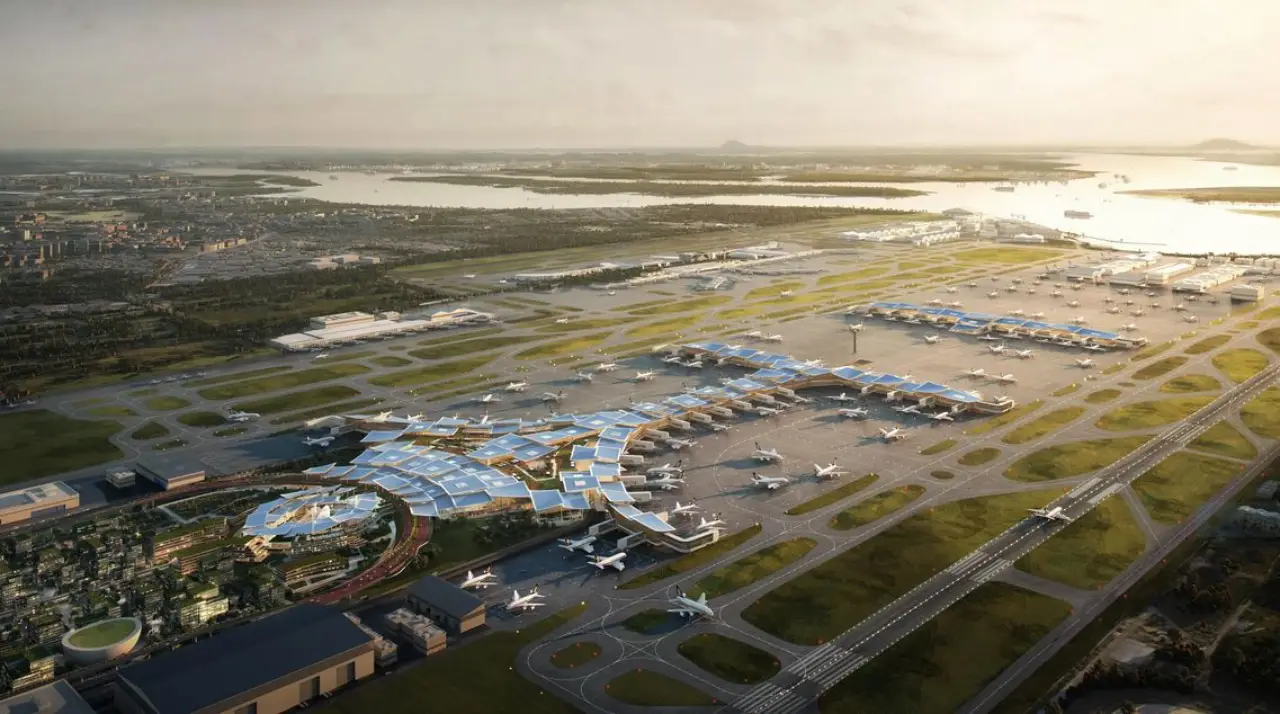
Changi Airport’s new Terminal 5 will expand Changi’s current capacity by more than 50% and allow it to serve about 50 million more passengers annually.
The new terminal is expected to take around a decade to complete, and will boost Changi’s total annual capacity to around 140 million passengers, up from 90 million now. The new mega terminal will have three sub-terminals spread over some 2 km.
Singapore Airlines and its budget arm Scoot will consolidate their operations under one roof at T5 when the terminal opens in the mid-2030s. Currently, SIA Group’s flights are split across the Terminals 1 to 3 of Changi Airport. These flights will be consolidated at T5, reducing transit and transfer time for passengers.
Construction work on T5 started when the Singapore Prime Minister Lawrence Wong officiated its ground-breaking ceremony in mid-May.
Asia Pacific comprises one third of global air travel market

Passenger traffic in the Asia-Pacific – already the world’s largest air travel market, taking about a third of the global share – is projected to double in the 2040s. Changi Airport Group said that the extra capacity at T5 will enable Singapore to take advantage of this growth.
Changi Airport handled a record 68.4 million passengers for the year ended March 31, 2025. Nearly 100 airlines operate more than 7,200 flights weekly at the airport.
It is the fourth-busiest international air hub in the world. In 2024, three of the 10 busiest international flight routes originated or ended in Singapore, and six of the 10 busiest international routes in South-east Asia took off or landed in Singapore.
Changi has around 170 city links, and the number is growing. With T5, Changi aims to reach its target of reaching more than 200 city links by the mid-2030s.
Smart Terminal

T5 is designed to withstand extreme weather and the effects of climate change, such as rising sea levels. The airfield is elevated at 5.5m above sea level, and aircraft taxiways will be sloped to allow rainwater to drain off. The airfield drainage system is designed to manage stormwater during high tide and handle intense rainfall from extreme storms.
Changi Airport Group said that Changi Airport will embark on an airport-wide transformation programme with the aim of “total airport management” through the use of intelligent systems and data.
T5 will incorporate state-of-the-art airport systems and automate passenger-facing and back-end functions like baggage-handling processes. It will leverage intelligent systems and data to optimise efficiency, safety as well as the passenger experience.
T5 will be a sustainable terminal, using smart building management systems, with AI-optimised air-conditioning, intelligent lighting, and hybrid cooling systems.
Plans include baggage robots that can operate in poor weather conditions, as well as video analytics and artificial intelligence tools that can track aircraft turnarounds to predict potential delays. A turnaround refers to the time between the arrival of an aircraft and its next departure. These technologies are being tested now to prepare for their roll-out when T5 opens.
Focus on sustainable features

T5 will be powered by more clean energy to reduce the airport’s carbon footprint.
T5 will have overlapping curved roofs with varying heights. It will also have natural light and landscaping.
The feasibility of installing a solar system on its roof is being studied. And if that happens, it will be the largest rooftop system in Singapore. It will also be ready to support viable alternative jet fuels, including sustainable aviation fuels.
From 2025, all new light vehicles, forklifts and tractors on the airside will be electric, and T5 will be able to support a fully electric airside fleet, according to Changi Airport Group as reported in The Straits Times.
A connected terminal
There will be an Automated People Mover system to bring passengers directly from T5’s arrival gates to the immigration halls and connecting it to the other terminals via this Automated People Mover network.
This will provide a more seamless connection experience across all the terminals in Changi and allow Changi to operate as a more integrated airport.
T5 will also be better connected to the rest of Singapore. There will be a dedicated ground transportation centre to bring together all the transfer options for passengers, be it car, taxi, MRT or bus.
T5 will be closer to the Tanah Merah Ferry Terminal, seamless air-sea transfers to destinations in neighboring countries such as Indonesia and Malaysia, will also be explored.
Images courtesy of Changi Airport Group