Paris has long been more than a destination; it has been a sanctuary for writers, a stage for philosophers, and a muse for dreamers. Across centuries, authors from France and beyond have found inspiration in its boulevards, bridges, and bookshops.
Today, travelers can walk in their footsteps, exploring the cafés where ideas flourished, the streets immortalized in novels, and the monuments that became literary symbols. To journey through Paris is to read the city itself—one chapter at a time.
Victor Hugo and the Soul of Paris
Victor Hugo, one of France’s greatest literary figures, etched Paris into the global imagination. His novel The Hunchback of Notre-Dame transformed the Gothic cathedral into more than a religious site—it became a symbol of justice, compassion, and resilience. Visitors who climb to the cathedral’s towers can almost hear the echo of Quasimodo’s bells, gazing out across the city as Hugo once did. Meanwhile, Les Misérables leads readers through the narrow alleys of the Latin Quarter and across the barricaded streets of revolutionary Paris. A walk along Rue Mouffetard or Place de la Bastille offers a tangible link to Hugo’s dramatic landscapes.
To experience Hugo’s Paris, travelers often visit the Maison de Victor Hugo at Place des Vosges, his former residence, now a museum. Nearby, Hôtel de Sully and the shaded arcades of Le Marais provide a glimpse into the atmosphere of the 19th century. Afterward, visitors may linger over dinner at Benoit, a historic Parisian bistro, imagining conversations that could have taken place in Hugo’s time.
Marcel Proust and Belle Époque Elegance
Marcel Proust captured the refinement and subtlety of Parisian life in In Search of Lost Time. His world was one of elegant salons, intellectual debates, and social rituals that unfolded in the city’s grand boulevards. For modern travelers, the Paris of Proust can be found at the Musée Carnavalet, which chronicles the history of Paris, and at the Jardin des Champs-Élysées, where leisure and sophistication intertwine.
One of Proust’s favorite haunts, Café de la Paix, remains a landmark of Belle Époque opulence, offering travelers a chance to sit where artists and aristocrats once gathered. To continue the Proustian journey, travelers might stay at Le Meurice or Ritz Paris, luxury hotels where the air still carries whispers of literary conversations and delicate Parisian intrigue.
The Expatriate Writers of the 1920s
The interwar years brought an extraordinary wave of international writers to Paris. Known as the “Lost Generation,” these expatriates found inspiration in the Left Bank’s bohemian streets. Ernest Hemingway captured the city’s essence in A Moveable Feast, portraying long days of writing in cafés and nights of camaraderie in Montparnasse. F. Scott Fitzgerald mingled with the same crowd, bringing his Jazz Age characters to life in Parisian soirées. James Joyce published Ulysses here, while Gertrude Stein hosted literary salons in her home at 27 Rue de Fleurus.
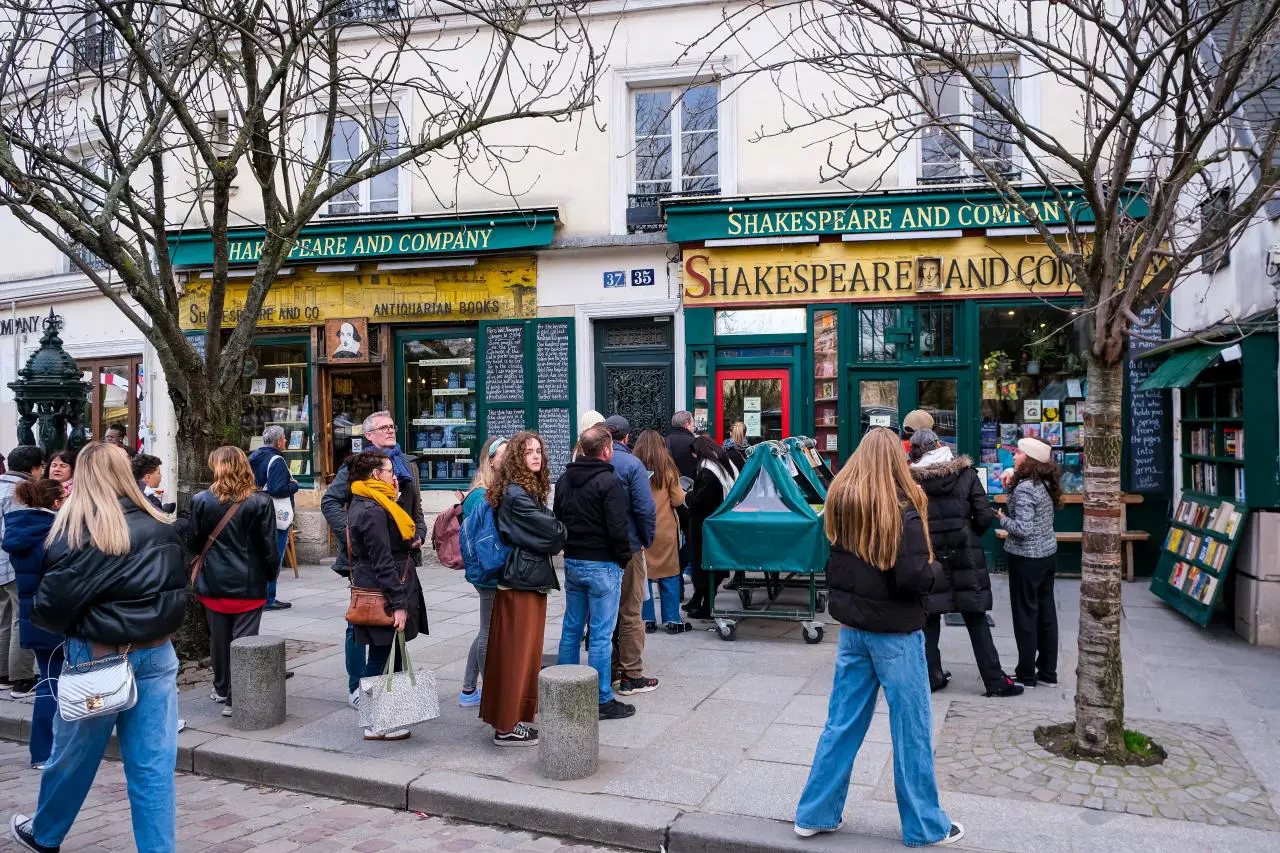
To explore this era, travelers head to Shakespeare and Company, the iconic bookshop near Notre-Dame that has been a refuge for writers since the 1920s. A walk through Saint-Germain-des-Prés leads to legendary cafés such as Les Deux Magots and Café de Flore, where Hemingway and Stein once lingered. For those seeking an immersive stay, Hôtel Lutetia on the Left Bank blends literary heritage with Art Deco luxury.

Existentialism and the Café Culture
After World War II, Paris became the epicenter of existentialist thought. Jean-Paul Sartre and Simone de Beauvoir debated freedom, responsibility, and love from the cafés of Saint-Germain-des-Prés. Visitors can retrace their steps by stopping at Café de Flore, where philosophical discussions once stretched into the night, or by visiting the Montparnasse Cemetery, their final resting place.
The Musée de Cluny, with its medieval artifacts, and the Panthéon, which houses the remains of Voltaire, Rousseau, and Hugo, provide cultural depth to the existentialist trail. For dining, travelers might seek out Brasserie Lipp, a Paris institution where intellectuals and writers gathered beneath Belle Époque mirrors.
Henry Miller and the Bohemian Vision
Henry Miller saw Paris in raw and sensual terms, immortalizing its energy in Tropic of Cancer. His Paris was bohemian, sometimes harsh, but always full of vitality. To glimpse this world, travelers may wander through the lively neighborhoods of Montmartre and Pigalle, once known for their cabarets and artists’ studios.
The Moulin Rouge remains a symbol of this bohemian era, while the Musée de Montmartre tells the story of the artists who once called the district home. Visitors might end their day with dinner at La Maison Rose, a pastel-colored bistro that has long been a gathering spot for creative spirits.
Practical Inspirations for Today’s Travelers
Exploring Paris through its authors offers more than literary nostalgia—it provides a framework for travel that is both cultural and personal. Museums such as the Musée d’Orsay and the Centre Pompidou highlight the artistic movements that paralleled literary currents, while the green bookstalls along the Seine remain a living reminder of Paris’s identity as a city of words.
To bring these stories to life, many travelers choose a guided literary tour, which connects landmarks with the works and lives of authors like Victor Hugo, Marcel Proust, and Ernest Hemingway. Expert guides add layers of history and anecdotes that enrich each walk, making the city’s literary heritage even more accessible.
For accommodations, options range from historic addresses like Hôtel Littéraire Marcel Aymé to boutique stays in Le Marais, where cobbled streets evoke the atmosphere of old Paris. Food lovers can pair their literary walks with meals at classic bistros, from Au Pied de Cochon near Les Halles to Michelin-starred dining at Arpège, where French gastronomy becomes an art form.
A City That Still Writes Its Story
Paris continues to inspire new generations of writers and travelers alike. Whether following Hugo’s footsteps through revolutionary alleys, Proust’s salons of elegance, Hemingway’s bohemian cafés, or Sartre’s philosophical haunts, the city reveals itself as a palimpsest of stories waiting to be read. Every quartier carries its own narrative, every café whispers of past conversations, and every landmark offers a glimpse into the Paris that once was—and still is.
For those who dream of travel, Paris proves that literature is not confined to the page. It is etched in stone, whispered in cafés, and alive in the rhythm of the city. To explore Paris through its authors is to discover a city that continues to write itself—one story, one walk, and one reader at a time.
Main Photo Credit: Alla Tsyganova / Shutterstock.com