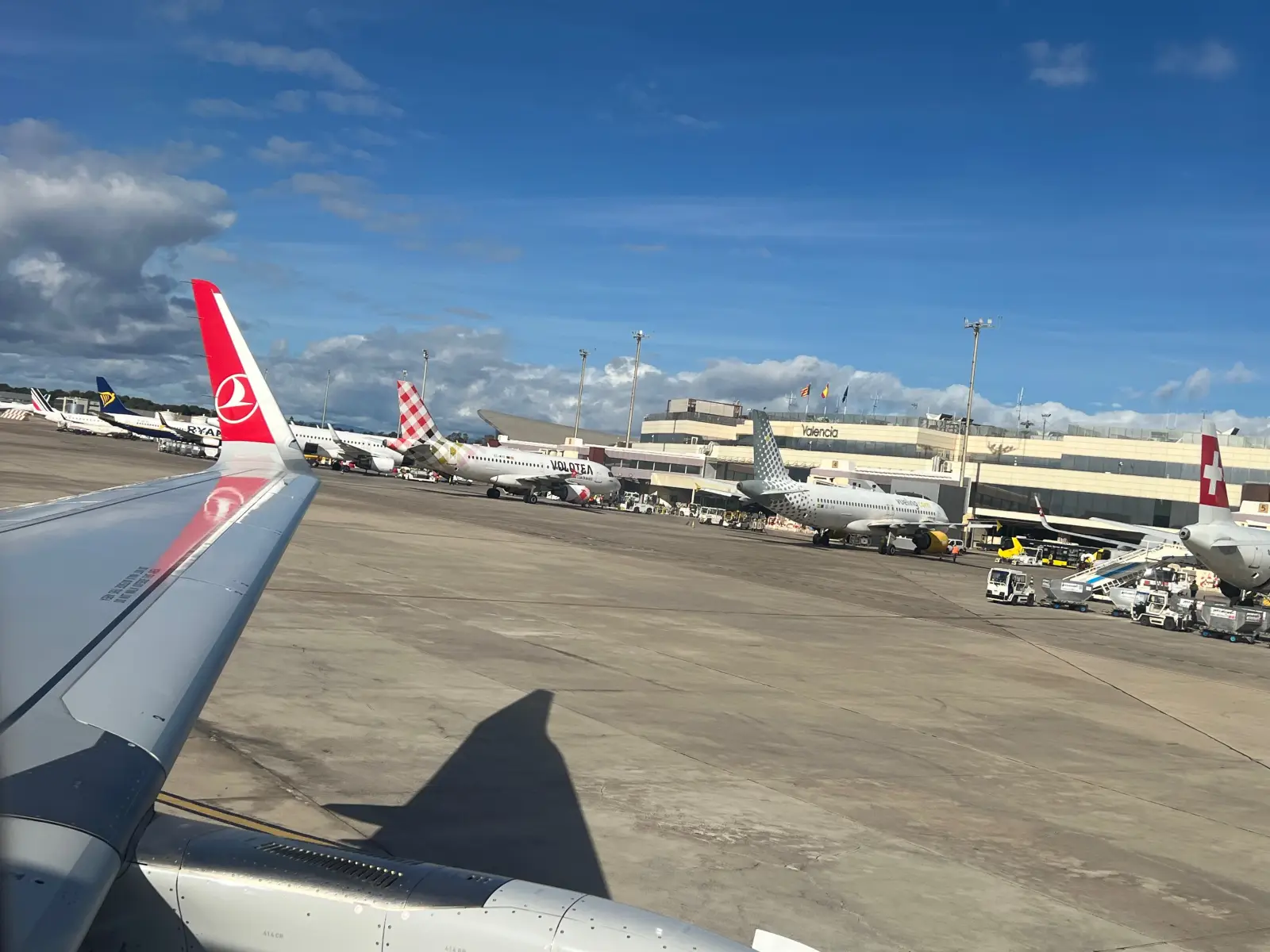
A Valencian political group has formally asked the Generalitat Valenciana to intervene over noise pollution linked to Valencia Airport, after official monitoring data showed repeated breaches of acoustic quality targets in several towns across the airport’s wider influence zone.
Compromis Quart, the local branch of the Valencian green-left party, triggered the administrative process on 15 June 2026 following an initial response from the regional ombudsman, the Sindic de Greuges. The ombudsman’s office told the party it could not act until the matter had first been raised formally with the competent authority and a substantive response had been received or withheld.
The request to the Generalitat asks the regional government to assess the situation under its powers over environmental quality, noise pollution, environmental information, public health and territorial coordination. Compromis Quart wants the administration to confirm what steps it can take and whether it holds its own data, acoustic maps, studies, action plans or monitoring measures related to airport noise.
The complaint was originally filed by Lluis Mi Campos, a councillor for Compromis and a resident of Quart de Poblet, one of the municipalities most directly affected by flight paths to and from Valencia Airport. The airport, formally known as Manises Airport and operated by Aena, handles around 835 flights per day and sits 8 kilometres west of the city centre, with its single runway cutting through a corridor that includes several densely populated towns.
According to the Spanish Ministry’s official 2025 annual noise report for Valencia Airport, the monitoring station in Quart de Poblet, located at the adult education centre on Luis Vives street, recorded 62.3 dB of total noise during the day, 63.7 dB in the evening and 61.5 dB at night. Aircraft-specific noise at the same point reached 56.9 dB in the daytime, 59.0 dB in the evening and 48.8 dB at night. The report notes that acoustic quality targets for total noise were exceeded across all three time periods at the Quart de Poblet monitoring station, though it attributes the breaches primarily to community noise in the surrounding area.
Compromis Quart says that attribution does not resolve the problem. Campos said residents needed clarity on what proportion of the disturbance came from the airport, what came from other sources, what mitigation measures were already in place and who was responsible for protecting local rights.
“We take note of what the Sindic tells us and we activate the route he indicates,” said Campos. “If the annual noise report confirms that acoustic quality targets are being exceeded, someone must take prior action. It cannot all be left to data provided by Aena or to technical reports that nobody explains to the affected residents.”
The report also identifies pressure points in other towns near the airport. Manises, which sits immediately adjacent to the runway and is considered the loudest zone in the airport’s influence area, recorded 60.1 dB of aircraft noise in the evening period. Aldaia‘s Barrio del Cristo recorded 52.1 dB of aircraft noise at night, while Xirivella reached 65.7 dB of total noise in the evening and 58.9 dB at night.
The towns named by Compromis Quart as affected include Quart de Poblet, Manises, Aldaia, Xirivella, Riba-roja de Turia and Valencia itself. The party says the scale of the issue means it cannot be treated as a local matter and requires a coordinated response involving the Generalitat, affected municipal councils, Spain’s central government and Aena.
Among the specific demands, Compromis Quart is asking whether the regional government would consider establishing independent monitoring or auditing systems so that acoustic data is not generated solely by Aena or the airport operator. The party also wants accessible public information on noise levels, night flights, runway configurations, periods of greatest impact and existing or planned noise mitigation measures.
The noise dispute around Valencia Airport sits within a wider regional debate about the right to rest and the obligations of public authorities under Spanish acoustic legislation. Local governments including Manises and residents’ groups have separately been campaigning for a night curfew at the airport between 23:00 and 07:00, citing precedents at Bilbao and Seville airports. As of 2026, that proposal remains under consideration but has not been implemented.
Campos said airport noise should not be treated as an unavoidable nuisance. He said that if the official reports confirmed breaches of acoustic quality targets, the authorities had a duty to act, and that if the response from the Generalitat was inadequate, Compromis Quart would return to the Sindic de Greuges with the administrative process formally completed.