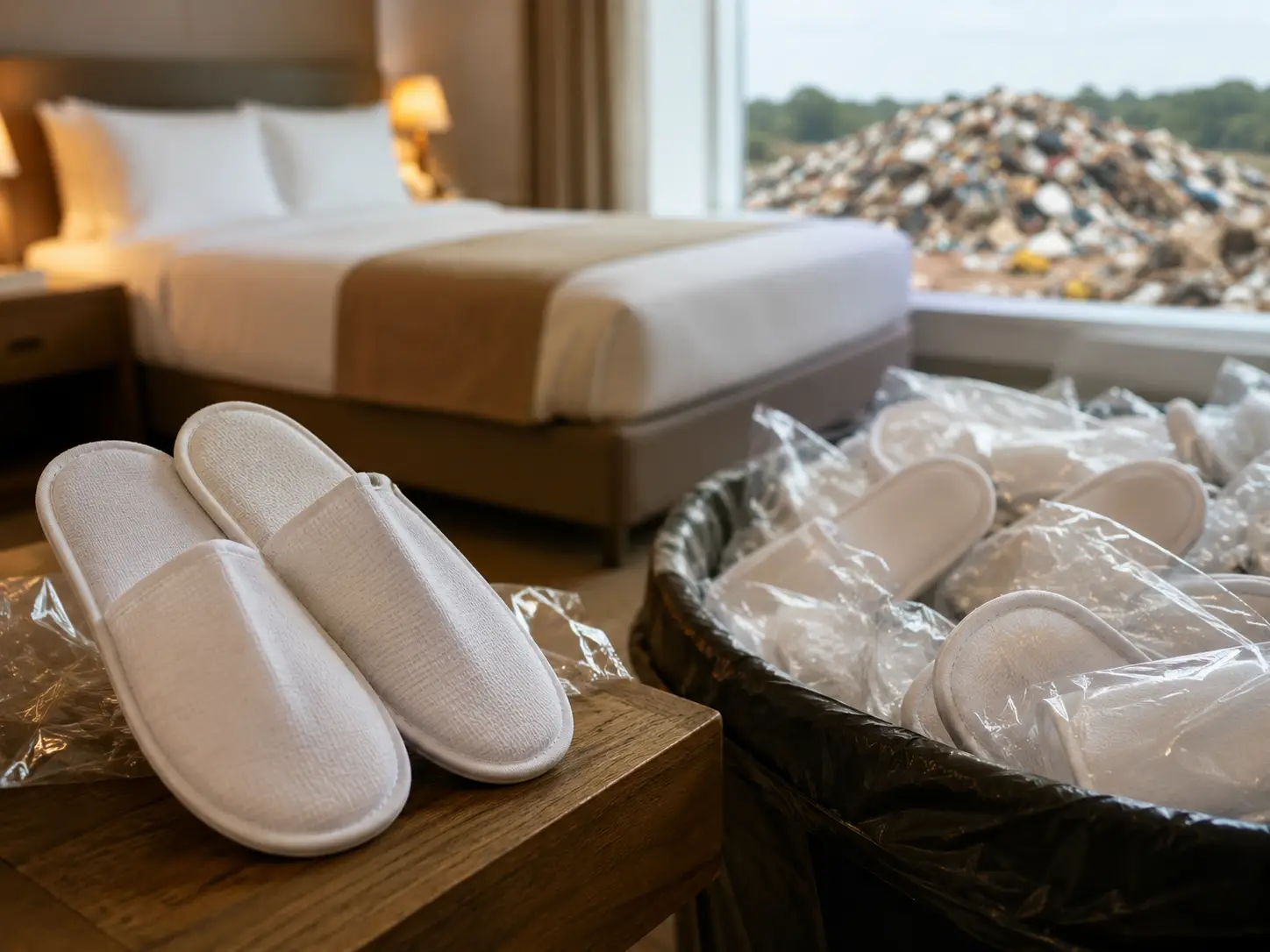
The disposable hotel slipper has become one of tourism’s most overlooked plastic waste problems, with hundreds of millions of pairs travelling from factories in eastern China to guest rooms and then to landfill sites after use measured in hours rather than days.
A report by The Times of London traced the journey of the slippers from Yangzhou, a city in Jiangsu province that has become a global hub for hotel amenities, to rubbish tips in some of the world’s busiest tourist destinations. The newspaper described the scale as striking, noting that the 100 biggest hotels in London alone could line enough slippers in a year to stretch from Hyde Park to Frankfurt. A further 1,500 hotels in the city also offer them to guests.
Cheap to Make, Slow to Break Down
The economics of the disposable slipper help explain how the problem has grown largely unnoticed. Standard pairs typically cost hotels as little as 7 cents each and are usually made from polypropylene and ethylene-vinyl acetate, two plastic-based materials that can take around 1,000 years to decompose in landfill conditions. More premium versions cost around 35 cents but remain made from similar materials and are rarely reused. They are typically packaged in non-recyclable plastic wrapping.
Genuinely recyclable alternatives, including slippers made with cork soles developed by companies such as Primal Soles in collaboration with Amorim Cork Solutions, are available for slightly under 1 euro per pair. However, the price difference and limited supplier adoption have kept greener options a niche within the market rather than a mainstream choice.
Yangzhou: The City Behind the World’s Hotel Bathrooms
Yangzhou, located in Jiangsu province, has evolved into one of the most significant manufacturing centres for hotel guest amenities globally. The city’s hospitality supply industry generates approximately 3 billion euros a year and produces not only slippers but also toothbrushes, shower caps, combs, shaving kits and other standard guest room items. Multiple Yangzhou-based suppliers, including companies in the Hangji Industrial Park, export amenity sets to hotel groups across Europe, the Americas and Asia, often at prices that reflect the extremely low unit cost of production.
The concentration of production in a single region means that a change in purchasing norms among major hotel chains could have a significant effect on both environmental outcomes and on the supply chain that currently depends on high-volume, low-cost orders.
The Greenwashing Gap
The Times report highlighted what it characterised as a credibility gap between the environmental commitments hotels make publicly and the amenities they continue to place in guest rooms. Many properties have adopted visible signals of sustainability, such as wooden-handled toothbrushes, refillable shampoo dispensers and in-room recycling bins, while continuing to supply guests with disposable plastic slippers that are rarely taken home and almost never recycled.
The pattern is consistent with a wider critique of greenwashing in the hospitality sector. Analysts and sustainability advocates have pointed out that hotels often prioritise high-visibility, low-cost changes while leaving larger sources of waste unaddressed. Disposable slippers are a clear example: they are low cost for the property, invisible in sustainability reports and yet accumulate in enormous numbers across the global industry.
Hans Pfister, president of the Cayuga Collection hotel group, which manages the Arenas del Mar resort in Costa Rica, described the logic of removing slippers from rooms after his housekeeping team raised the issue. “It didn’t make sense because you use them once and throw them out,” he said. “It’s very wasteful.” The group now provides slippers only on request.
Regulation Is Moving, but Slowly
China, the country that manufactures the majority of hotel slippers and amenities sold globally, has introduced regulatory measures targeting single-use plastic products in the hospitality sector. The Ministry of Commerce requested in 2020 that all star-rated hotels stop providing disposable plastic items voluntarily by the end of 2022, with the requirement extended to cover all hotels and guesthouses nationwide by the end of 2025. Major international hotel groups operating in China, including Hilton and Shangri-La, have set internal targets for reducing per-room plastic consumption.
However, enforcement outside China remains largely voluntary. In most markets, hotels face no legal obligation to remove disposable slippers, and industry pressure has not yet produced significant change in standard purchasing practices.
Alternatives Exist but Face Slow Adoption
Several companies have developed slipper designs intended to address the waste problem. Feelgoodz, a North Carolina-based footwear company, launched a hotel slipper collection in October 2025 offering both a take-home model and a reusable, washable version designed for repeat use across multiple guest stays. The company stated that millions of single-use slippers end up in US landfills every month.
Sustainable materials including organic cotton, bamboo, recycled PET fabric and cork are all technically viable for slipper production and are already used by specialist suppliers. The barrier to wider adoption is primarily one of cost and procurement habit rather than the absence of solutions.
A Small Item With a Long Footprint
For travellers, the slipper serves as a reminder that the environmental cost of a hotel stay extends well beyond energy and water use. For hotels, the case for change is both environmental and reputational: as guests become more aware of greenwashing, the gap between a property’s sustainability messaging and the plastic-wrapped slipper in the closet becomes harder to ignore.
The hospitality industry has successfully moved away from other single-use items under a combination of regulatory pressure and consumer expectation. Plastic straws, individual shampoo bottles and disposable toiletry kits have all been phased out or restricted at a growing number of properties. Industry observers say the disposable slipper is likely to follow the same path, but the timeline remains unclear.